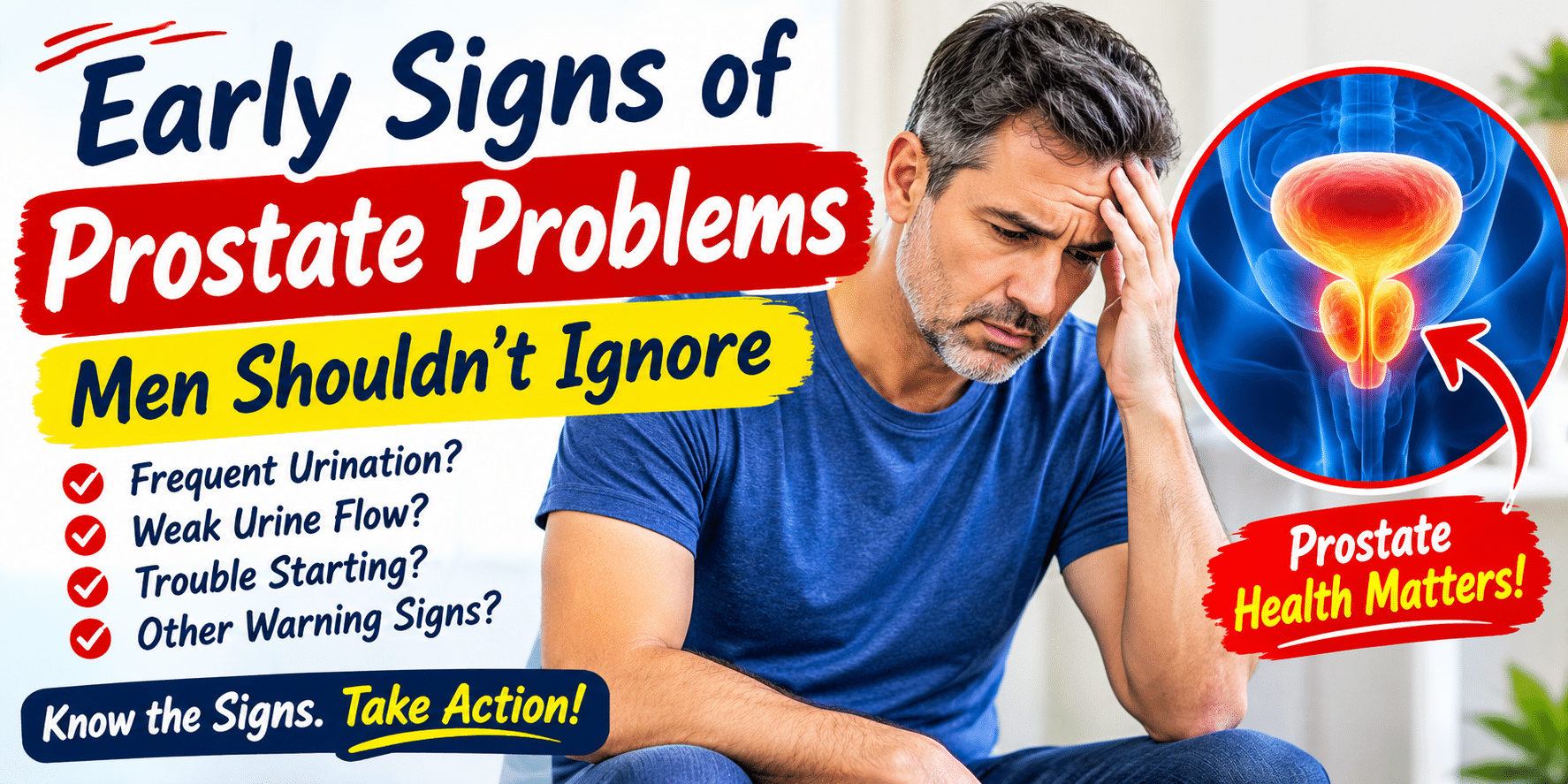
Early Signs of Prostate Problems Men Shouldn’t Ignore
Last Updated On November 24, 2026 by Robert Dowling
Most men don’t think about their prostate until it makes itself known, usually at 2 a.m., standing in a dark bathroom, waiting for a stream that doesn’t come.
Here’s the part that surprises people: those changes are very rarely cancer. But the same quiet symptoms can sometimes point to something that needs treatment, and early prostate problems are easy to wave off as “just getting older.” This guide covers which signs matter, what usually causes them, and when to book an appointment.
First, a Quick Reality Check on the Prostate
The prostate is a walnut-sized gland that sits just below the bladder and wraps around the urethra, the tube that carries urine out. When the gland grows or gets inflamed, it squeezes that tube. Most early symptoms come from that squeeze.
Three conditions account for most prostate trouble: inflammation (prostatitis), enlargement (benign prostatic hyperplasia, or BPH), and cancer. They overlap a lot in how they feel, which is why guessing at home doesn’t work.
👉 [Discover This Prostate Supplement]
Urinary Changes: The Signs Most Men Notice First
A weak or stop-start stream
If you used to hit the urinal with confidence and now it’s more of a trickle, pay attention. Other versions of this include straining to get started, a stream that stops and restarts, or dribbling at the end. An enlarged prostate can push against the urethra and bladder, causing pushing or straining to begin a urine stream and a need to go more often, especially at night.
Waking up at night to pee
Once a night is common. Two or three times, every night, is worth mentioning to a doctor. Nocturia is one of the symptoms men tolerate longest, partly because they assume it’s normal. It can quietly wreck your sleep and your mood during the day.
Urgency and the feeling you’re never quite finished
A sudden “I have to go right now” feeling, or the sense that your bladder isn’t fully empty even after you’ve gone, are classic prostate-related complaints. Urologists often score these on a simple questionnaire called the International Prostate Symptom Score (IPSS). It’s seven questions, and you can find it online.
Less Obvious Signs That Deserve Attention
Urinary changes get the headlines, but they aren’t the only clues.
- Blood in urine or semen. Always worth checking. It has many causes, and most aren’t serious, but it should never go unexamined.
- Pain or burning when urinating or ejaculating. More typical of prostatitis or infection than cancer, but it still needs treatment.
- Pelvic, lower back, or hip pain that won’t go away. Locally advanced prostate cancer may cause blood in the urine or semen, or pain in the back, hips, or pelvis that persists.
- Urinary tract infections that keep returning. Men with chronic bacterial prostatitis often get UTIs that come back after treatment. In men, a recurring UTI is unusual enough that doctors look for a cause.
- Erectile changes. These have many causes, including blood pressure, diabetes, stress, and medication. Prostate cancer can also interfere with erections. It’s rarely the first sign, but it’s part of the picture.
BPH, Prostatitis, or Cancer? How They Compare
| BPH (enlarged prostate) | Prostatitis | Prostate cancer | |
| Typical age | 50+ | Any adult age, often younger | Mostly 50+ |
| Early symptoms | Weak stream, frequency, nighttime urination | Pain, burning, pelvic discomfort | Often none |
| Onset | Gradual, over years | Can be sudden | Slow, often silent |
| Common clue | Hesitancy and incomplete emptying | Pain or flu-like feeling | Usually found through screening |
Don’t treat this table as a self-diagnosis tool. Its main message is that the symptoms blur together.
Why Most Symptoms Aren’t Cancer (And Why That Shouldn’t Make You Relax)
BPH is simply very common. According to the American Urological Association, about half of men aged 51 to 60 have it, rising to as many as 90% of men over 80. And having BPH doesn’t raise your risk of prostate cancer.
That’s genuinely reassuring. It also creates a trap. Because the early symptoms are usually harmless, men get used to ignoring them. Meanwhile, most men diagnosed with prostate cancer, including many with advanced disease, don’t have symptoms when it’s found. A Harvard Health specialist adds that urinary symptoms that appear very rapidly are a red flag, since that pattern would be unusual for BPH.
So the rule isn’t “panic at every symptom.” It’s “don’t let a harmless explanation stop you from getting checked.”
Untreated BPH isn’t harmless either. It can occasionally lead to frequent urinary infections or kidney problems. Treating it mostly makes life better, and it can prevent those complications.
👉 [Explore This Prostate Support Formula]
Who Should Be Paying Closer Attention?
Risk isn’t evenly spread.
- Age. Only about 1 in 451 men are diagnosed before 50, but by age 70 the odds are around 1 in 12.
- Family history. Risk is higher if a father, brother or uncle has had prostate cancer.
- Ancestry. Black men are about 70 percent more likely to be diagnosed and also more likely to die from it. Researchers haven’t fully explained why, but it’s the reason many guidelines suggest starting conversations about screening earlier.
If any of these apply to you, don’t wait for symptoms.
What Happens When You Finally Get Checked
Many men put this off because they imagine something worse than the reality. A typical first visit looks like this:
- A conversation and symptom questionnaire. Often the most useful part.
- Urine test. Rules out infection.
- PSA blood test. Measures prostate-specific antigen. PSA rises with both BPH and cancer, because a larger or more irritated gland releases more of it. A high number means “look closer,” not “you have cancer.”
- Digital rectal exam. Brief and uncomfortable at worst.
- Possibly an MRI. Many centers now use MRI before a biopsy, which has helped avoid unnecessary biopsies.
The Screening Debate, Honestly
PSA screening is genuinely controversial. The large European trial (ERSPC) found that screening lowered prostate cancer deaths by roughly 20 percent. But screening also finds slow-growing cancers that would never have caused harm, which can lead to over treatment and side effects.
Newer research makes the picture less frightening. In the UK’s Protect trial, about 97 percent of men with localized prostate cancer were still alive from the disease after 15 years, whether they were treated or monitored closely. Roughly 95 percent of men diagnosed survive at least 15 years. That’s why “active surveillance” (watching a low-risk cancer instead of treating it right away) is now common.
The takeaway: screening is a decision to make with your doctor, based on your age and risk, not a blanket yes or no.
When to See a Doctor Soon
Don’t wait for your next routine checkup if you notice:
- Blood in your urine or semen
- Pain in your lower back, hips, or pelvis that doesn’t ease
- Fever with painful urination
- Being unable to urinate at all (go to the emergency room)
- Rapid worsening of urinary symptoms
For anything milder, like a weaker stream or more nighttime trips, book an appointment within a few weeks. Nothing about it is urgent, but there’s no reason to put up with it.
A Few Habits That Help
Nothing here replaces medical care, but these are reasonable. There’s some evidence that obesity and cardiovascular or diabetes risk factors are linked to a higher chance of an enlarged prostate. Staying active, keeping a healthy weight, and cutting back on evening caffeine and alcohol often calm nighttime bathroom trips. Don’t take supplements like saw palmetto expecting results. Studies haven’t shown they work better than placebo.
👉 [Check Out This Prostate Health Formula]
The Bottom Line
Prostate problems rarely announce themselves loudly. A slower stream, a few extra bathroom trips, a nagging ache: these feel too minor to mention, and that’s exactly why they get missed. Most of the time the cause is treatable and benign. Occasionally it isn’t, and catching it early changes everything.
If you’ve noticed even one of these signs for more than a few weeks, make the call. The appointment is short, and not knowing is worse.
This article is for general information and isn’t a substitute for medical advice from a qualified doctor.